Categories
Ham Satellite news

GRAIL i bana runt Månen

Nu har NASA proberna Grail A och B placerat sig i bana runt Månen för att med stor precision utforska månen.

Mera information på  http://www.nasa.gov/mission_pages/grail/main/index.html

Det är flera månstudsstationer som har hört signalerna på frekvenserna 2279.503 samt 2280.592.

Categories
Ham Satellite news

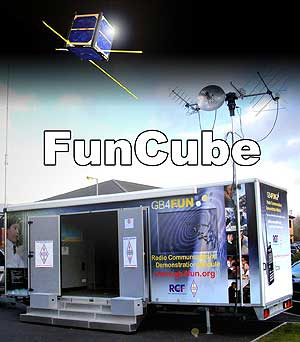
Funcube satelliten

Nu verkar det som att att Funcube kommer upp i rymden under 2012.

Läs mer på   http://funcube.org.uk/ samt http://www.uk.amsat.org/3239

Den här satelliten kommer att vända sig väldigt tydligt till skolor och kan bli ett intressant verktyg i undervisningen. Man kan lätt föreställa sig entusiasmen i att följa satelliten på datorskärmen för att sedan kunna börja ta emot mätdata när den dyker upp vid horisonten.  En engagerad lärare kan mycket väl väcka ett intresse och yrkesval för livet.

Categories
Ham Satellite news

ARISSat på väg att brinna upp

Den lilla satelliten som skickades ut från ISS är nu på väg in i atmosfären och har säkerligen inte lång tid kvar. Under nyårshelgen har den vid solbelysning sänt röstmeddelanden samt telemetri och fina SSTV bilder.

En satellitamatör som satsat hårt på att dokumentera trafik och bilder från satelliten är Mike DK3WN som har en mycket bra hemsida.   http://www.dk3wn.info/sat/afu/sat_arissat.shtml

Categories
Ham Satellite news

Gott nytt år!

AMSAT-SM önskar ett Gott Nytt År! Vi fortsätter att förmedla satellitnyheter under 2012 och hoppas att det blir mycket aktivitet på alla de små amatörradiosatelliter som finns till vårt förfogande.

Mvh AMSAT-SM styrelse

Categories
Ham Satellite news

Dax att hjälpa till att få upp Fox-1

Nu är det dax att hjälpa till att få upp nya Fox-1 satelliten!  Se nedan info från AMSAT-NA.

Help AMSAT to Fly Fox-1: Solar Panel Campaign Begins

AMSAT News Service Bulletin 359.01
From AMSAT HQ SILVER SPRING, MD.
December 25, 2011
To All RADIO AMATEURS
BID: $ANS-359.01

As AMSAT embarks on the Fox-1 Project, here is an opportunity to
literally put your callsign on the Fox hardware. AMSAT is looking
for major donations to help underwrite the cost of solar cells/
panels, one of the more significant expenses of the project. These
solar cells are needed for the flight unit as well as for the a
flight spare. As Fox-1 will have solar cells on all six sides of
the spacecraft and given the relatively small surface area avail-
able on each side (at most 4″ by 4″ per side), AMSAT will invest in
high efficiency solar cells to gain as much power as possible to
operate the spacecraft.

To protect the installed solar panels prior to launch, a lexan cover
for each side will be fabricated and mounted to protect the cells.
Prior to placement of the flight spacecraft into the ‘P-Pod’ that
will house the cubesats on the launch vehicle, the lexan covers will
be removed.

“Friends of Fox” are encouraged to consider several levels of fund-
ing support:

1. Donate $1,000 to support purchase of one panel that will cover
one side of the spacecraft.

2. Donate $6,500 to support the purchase of six sets of solar panels
to cover the entire spacecraft.

Donors who contribute at these levels will have their callsign etched
on the lexan cover protecting solar panels of the flight unit and the
flight spare. Following the launch of Fox-1, donors will receive the
lexan solar panel cover with their callsign for ‘their’ solar panel
mounted on a plaque commemorating their contribution to the Fox-1
project and highlighting the purpose of the lexan cover. A letter of
authenticity will be provided attesting to the use of the lexan cover
to help protect the solar panels.

Other potential donor levels are also available:

1. Donate $500 for one solar cell (two cells make up a ‘panel’ on
one side of the spacecraft).

2. Donate $250 for one-half of a solar cell (one-quarter of the
solar panel for one side of the spacecraft.

Donors contributing at these levels will receive a letter affirming
their contribution, including specifying which side of the spacecraft
‘their’ cells are located.

If you’re interested in supporting AMSAT’s need to purchase solar
cells, please return the Fox-1 fundraisingform sent to members. We
expect significant interest so make your donation NOW to take full
advantage of this donation opportunity.

Additional donation opportunities may be found at:

+ Call Martha at the AMSAT Office +1-888-FB AMSAT (1-888-322-6728)
+ Paypal donation widget on the main page at: http://www.amsat.org
+ Paypal donation widget for Project Fox at:
http://www.amsat.org/amsat-new/fox/
+ You can also go to the Paypal site and send your donation to
martha@amsat.org.
+ The AMSAT Store: http://www.amsat-na.com/store/categories.php

All donations over $40 will receive a Fox pin. Donations of $120 or
more qualify you for AMSAT President’s Club

[ANS thanks AMSAT President Barry Baines, WD4ASW for the above
information]

Categories
Ham Satellite news

50 år sedan Oscar-1

50 år sedan den första amatörradiosatelliten Oscar-1!  Det firas av AMSAT i USA:

This Week 50 Years Ago: OSCAR 1 in Orbit

AMSAT News Service Bulletin 352.04
From AMSAT HQ SILVER SPRING, MD.
December 18, 2011
To All RADIO AMATEURS
BID: $ANS-352.04

The AMSAT News Service is re-running the Project OSCAR Newsletters
to commemorate the 50th anniversary of OSCAR 1. During the November/
December 2011 time frame you will be able to share the excitement of
the launch campaign that started it all 50 years ago.

This week is the last installment in the replay of these historic
newsletters.

The Newsletters were hand-typed back in 1961. Thanks to Don Ferguson,
KD6IRE for scanning the original documents announcing OSCAR 1.

-----
<Begin Commemorative Message>

O S C A R    N E W S L E T T E R

December 21, 1961

As of December 19, 1961 (one week in orbit) the amateur radio satel-
lite Oscar I had completed 104 revolutions about the earth on a North-
South-North orbit. Reports are beginning to pour into the Oscar Head-
quarters. A total of 296 reports from ll foreign countries have been 
received, with radio messages indicating more are on the way. Mail 
has been delayed because of the Christmas rush, but it is hoped that 
future reports will reach us more rapidly. Reports have proven to be 
consistent and accurate enough for use in generating tracking predic-
tions. Telemetry information provided by the keying rate indicates 
that Oscar I is running a fever. Recent data establishes the tempera-
ture of the package to be l25°F.

The following is a summary of the Oscar 1 satellite:

+ Frequency: Approximately 144.983 Mc. Power Output: 100+ milliwatts
+ HI-rate: Proportional to temperature. (IO HI's in 30 seconds = 64°F).
+ Tumble rate: Approximately 20 seconds.
+ Apogee: (Point farthest from the earth) - Approximately 275 miles.
+ Perigee: (Point closest to the earth) - Approximately 150 miles.
+ Orbital Period: Approximately 92 minutes. 
+ Total Doppler Shift: Approximately 6.5 kc.(Frequency received-is 
  higher than transmitted when satellite is approaching your station; 
  lower when going away).
+ Transmitter: Transistor crystal oscillator on 72.5 mc., transistor 
  amplifier and "Veri-cap" diode doubler to 145 mc. Keyer consists 
  of transistor multi-vibrator and counters with diode logic. Oscil-
  lator is keyed in base circuit.
+ Power Supply: Mercury batteries. Expected life of batteries: 3 to 
  4 weeks.
+ Antenna: 1/4-wave monopole, about 19 inches long. 
+ Dimensions and weight: 12" x 10" x 8". Weight: 10 pounds.

All daytime passes are from North to South: All nighttime passes 
are from South to North. A preliminary review of a sample of reports 
for one pass provides some interesting information. The acquisition 
times and fade-out times correlate closely among all the receiving 
stations in the same area. Further, the correlations have improved 
noticeably for the later orbital passes. This emphasizes that opera-
tors are gaining experience and that the predictions have been suffi-
ciently accurate to permit early acquisition. 

Many amateurs have been surprised at the great range which may be 
spanned by this beacon, whose output power is about 1/4 that requir-
ed to light a flash-light bulb. Reports indicate reliable reception 
up to a distance of about 1400 miles from the satellite path. On an 
overhead pass, signal reports of 40 decibels above noise level are 
common!

The Oscar Data Reduction group has reported a few messages indicat-
ing 'that the last dot of the letter "I" has been missing. Anybody 
noticing this who has a tape recording of the "missing dot" is re-
quested to air mail it to the Association as soon as possible.  

Reports of the "HI" rate are urgently requested. If the temperature 
inside the package continues to rise, it is possible that the opera-
ting life of Oscar could be cut short by a high temperature failure 
of some component. The temperature rise does not seem linear, so all 
reports will be welcome! Also, please monitor the frequency in off-
hours to determine if Oscar can be heard by unusual propagation 
modes at great distances! 

Orbital data is being broadcast by W1AW (see QST for schedules) and 
by the Voice of America "Space-Warn" program on various frequencies 
(9.525, 11.79, 11.83, and 15.29 mc) at 0330 GMT, Monday through Sat-
urday.

Send all reception reports of Oscar to: Project Oscar Association,
Box ---, Sunnyvale, California, U.S.A.
Thanks for your splendid cooperation and keep up the good work! 73.

<End of Commemorative Message>

[ANS thanks Don Ferguson, KD6IRE and Project OSCAR for the above
 information]