
Categories
Hamradio from ISS

Upcoming ARISS Contact Schedule as of 2018-10-17

Hörbara i Sverige:
Quick list of scheduled contacts and events:

Integrierte Gesamtschule Osterholz-Scharmbeck, Osterholz – Scharmbeck, Germany and Gymnasium Soltau, Soltau, Germany, direct via DN3HB and DN5ABG

  • The ISS callsign is presently scheduled to be DPØISS
  • The scheduled astronaut is Alexander Gerst KF5ONO
  • Contact is a go for: Tue 2018-10-23 09:14:26 UTC 63 deg (***)

Martin-Andersen-Nexö-Gymnasium Dresden/DLR_School_Lab TU Dresden, Dresden, Germany, and Liborius-Gymnasium Dessau, Dessau-Roßlau, Germany, direct via DLØTSD and DKØLG

  • The ISS callsign is presently scheduled to be DPØISS
  • The scheduled astronaut is Alexander Gerst KF5ONO
  • Contact is a go for: Wed 2018-10-24 08:22:55 UTC 78 deg (***)
Categories
Hamradio from ISS

ARISS-kontakt hörbar i SM 2018-10-10

Den 10:e oktober 2018 är det en ARISS-kontakt som kan vara hörbar i SM. Läs mer:

An International Space Station school contact has been planned for Alexander Gerst KF5ONO with Robert-Mayer-Gymnasium, Heilbronn, Germany and Realschule & Gymnasium Weingarten, Weingarten, Germany. The event is scheduled Wednesday 10 October 2018 at approximately 14.03 UTC (16:03 CEST).  The conversation will be conducted in German.

The contact will be a direct operated by DN1RMG and DN2RV. The downlink signals will be audible in parts of Europe on 145.800 MHz FM.

Categories
Hamradio from ISS

ARISS-kontakt med SM5SRR som moderator

Dessutom webcastas det på www.ariotti.com

ARISS contact for school in India to be webcast. As announced, an International Space Station school contact has been planned with Vidya Mandir Inter College, Meerut, India.
The event is scheduled Thursday 23 August 2018 at approximately 08:22 UTC (10:22 CEST).

The contact will be a telebridge operated by IK1SLD. Downlink signals will be audible in Europe on 145.800 MHz FM. Moreover the contact will be webcast on www.ariotti.com

73,

Gaston Bertels ON4WF

Categories
Hamradio from ISS

ARISS kontakt hörbar i Sverige 2018-08-13

Här finns en kort inspelning av, som det verkar, en kontakt som nog inte riktigt gick som planerat:


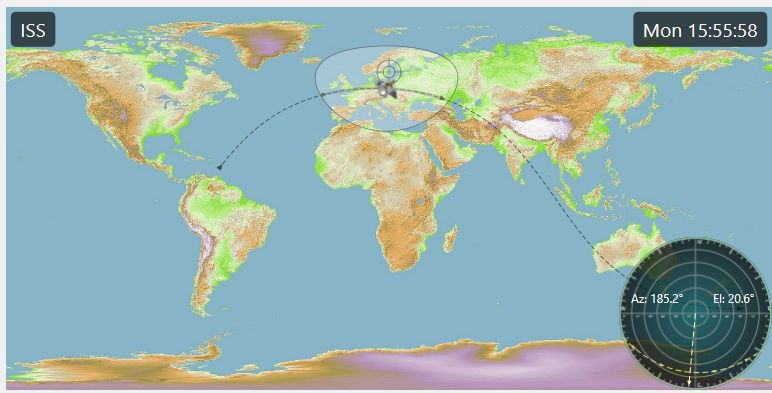
Nu har vi möjlighet att höra en skolkontakt via ISS (ARISS) på måndag 2018-08-13. Footprint enligt följande:

Upcoming ARISS Contact Schedule as of 2018-08-07 18:00 UTC

Quick list of scheduled contacts and events:

Nagoya Technical High School, Nagoya, Japan, direct via JA2YNI

The ISS callsign is presently scheduled to be NA1SS

The scheduled astronaut is Ricky Arnold KE5DAU (***)

Contact is a go for: Mon 2018-08-13 09:23:09 UTC 82 deg (***)

Matthes-Enderlein-Gymnasium Zwönitz, Zwönitz, Germany and Hohenstaufen-Gymnasium Kaiserslautern, Kaiserslautern, Germany, direct via DLØMEG and DLØXK

The ISS callsign is presently scheduled to be DPØISS

The scheduled astronaut is Alexander Gerst KF5ONO

Contact is a go for: Mon 2018-08-13 13:48:27 UTC 56 deg (***)

DLR_School_Lab Braunschweig, Braunschweig, Germany, direct via DN2DLR

The ISS callsign is presently scheduled to be DPØISS

The scheduled astronaut is Alexander Gerst KF5ONO

Contact is a go for: Tue 2018-08-14 12:56:59 UTC 76 deg (***)

Categories
Hamradio from ISS

Mer SSTV från ISS 30-31 juli 2018

Det kommer ännu mera SSTV-sändningar från ISS på 145.800 MHz FM den 30 och 31 juli 2018. Läs mer:

ARISS Russia is planning another of their popular MAI Slow Scan Television (SSTV) experiment events. Transmissions are scheduled to begin at 16:00 UTC on July 30, then powered down at 19:30 UTC. The next day (July 31), the system will be active from 13:25-19:15 UTC. Downlink should be on the traditional 145.80 MHz frequency and the operating mode will likely be PD120.

When this event becomes active, SSTV images are downlinked from the International Space Station (ISS) at the frequency of 145.80 MHz and can be received using ham radio equipment as simple as a 2 meter handheld radio or a common scanner receiver the covers the 2 meter ham band. After connecting the audio output of the radio receiver into the audio input of a computer running free software such as MMSSTV, the SSTV images can be displayed.

Please note that the event is dependent on other activities, schedules and crew responsibilities on the ISS and are subject to change at any time.
Please check for news and the most current information on the AMSAT.org and ARISS.org websites, the AMSAT-BB@amsat.org, the ARISS facebook at Amateur Radio On The International Space Station (ARISS) and ARISS twitter @ARISS_status.

About ARISS
Amateur Radio on the International Space Station (ARISS) is a cooperative venture of international amateur radio societies and the space agencies that support the International Space Station (ISS). In the United States, sponsors are the Radio Amateur Satellite Corporation (AMSAT), the American Radio Relay League (ARRL), the Center for the Advancement of Science in space (CASIS) and National Aeronautics and Space Administration (NASA). The primary goal of ARISS is to promote exploration of science, technology, engineering, and mathematics (STEM) topics by organizing scheduled contacts via amateur radio between crew members aboard the ISS and students in classrooms or public forms. Before and during these radio contacts, students, educators, parents, and communities learn about space, space technologies, and amateur radio. For more information, see www.ariss.org.

Also join us on Facebook: Amateur Radio on the International Space Station (ARISS)

Follow us on Twitter: ARISS_status

Dave Jordan, AA4KN
ARISS PR

Categories
Hamradio from ISS

SSTV från ISS fortsätter på 145.800 MHz

SSTV-sändningarna från ISS fortsätter ett tag till på 145.800 MHz. De kör mycket effekt och det går att lyssna på en handapparat.

SSTV transmissions from the Russian Service module on the
International Space Station started June 29 on 145.800 MHz FM and
they are still continuing

There may well be further transmissions up until July 13 when the
equipment being used for the SSTV will be required for a school
contact.

David Boult G7HCE in Exeter noted that some adjustments have been
made by the cosmonauts and the images are now being sent uncropped.
For the first week the edges of the pictures were missing.

The images commemorate the various satellites that were hand-
deployed from the ISS. These will include the first satellite
deployment from ISS: Suitsat-1/Radioskaf-1 which was developed by
ARISS and deployed in February 2006.

The transmissions are being made on 145.800 MHz FM using the PD-120
SSTV mode.

Note the ISS transmissions use the 5 kHz deviation FM standard
rather than the narrow 2.5 kHz used in Europe. If your transceiver
has selectable FM filters try using the wider filter. Handheld
transceivers generally have a single wide filter fitted as standard
and you should get good results outdoors using just a 1/4 wave whip
antenna.

The ISS Fan Club site will show you when the space station is in
range http://www.issfanclub.com/

ISS SSTV information and links at
https://amsat-uk.org/beginners/iss-sstv/

[ANS thanks Southgate ARN for the above information]