Categories
Ham Satellite news

D-star länkar

Jag har fått tips på några länkar om D-star som kanske kan vara intressant även fast det inte direkt är kopplat till satelliter:

För er som är nyfikna på D-star och vill veta lite hur det låter så går det att lyssna live via RadioReference.com.

http://www.radioreference.com/apps/audio/?action=cwp&ctid=321

Här är en till livestream från Usa.Reflector 30c Georgia / SouthEast Repeaters

http://www.radioreference.com/apps/audio/?feedId=1647

Här är en livestream från New England

http://www.radioreference.com/apps/audio/?feedId=5031

Här hittar du PAPA System D-Star Reflector

http://www.radioreference.com/apps/audio/?feedId=5429

Categories
Ham Satellite news

MASAT-1 (MO-72) Team Releases Software

The MASAT-1 team said this week that updated client software for
telemetry reception and decoding is available on their web at:
http://cubesat.bme.hu/en/radioamatoroknek/kliens-szoftver/

Some of the upgrades include:
+ The “Offline” label removed, the status of the automatic
packet reporting is displayed.

+ Battery voltage constant (on the EPS panel) updated.

+ User selection between 626/1250 bps decoding.

+ The waterfall display shows tracks for the 0, CW and 1. The
decoder has been reported to be most successful if tuning is
set upward by 50-100 Hz from the tuning indicators. User
experiences are invited to be sent to mezei@cubesat.bme.hu.

The automated received packet upload from the client software has
been updated to accept ham@cubesat.bme.hu or a@a.a as mail address
for those not wishing to send their actual address. Users can change
the e-mail address by editing the registration.txt file in the pro-
gram folder of the software package.

A statistics web page reporting on the numbers of packets forwarded
by amateur radio operators has been added:
http://cubesat.bme.hu/en/radioamatoroknek/veteli-statisztika/
The site has successfully received over 50000 packets from around
the world. The latest updates to the web and client software should
address initial concerns that ‘no packets’ have been received.

The MASAT-1 team thanks amateur radio operators for your outstanding
support. The MASAT-1 Important News for Radio Amateurs page is at:
http://cubesat.bme.hu/en/2012/02/19/fontos-hirek-radioamatoroknek/

The MASAT-1 mission home page is: http://cubesat.bme.hu

Categories
Ham Satellite news

Nytt online spårningsprogram

Thomas Lindblad tipsade om spårningsprogrammet Binary Space som finns följande adress:

http://www.hobbyspace.com/SatWatching/SatTracking-BinarySpace/index.html

Categories
Ham Satellite news

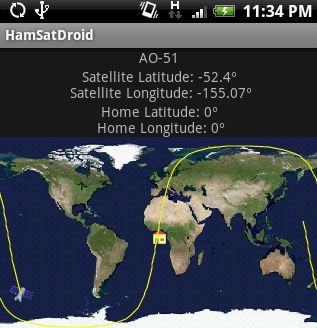
HamSatDroid – Spårningsprogram för Android

Nu finns en ny version av HamSatDroid som är ett spårningsprogram för Android:

Dave Johnson, G4DPZ announced a new version of the free HamSatDroid
app now available on the Android Market.

Upates to the app include:

+ tracking algorithm uses Dave’s SGP4 implementation, as GENSO.
+ plot three orbits ahead on the map
+ plot the footprint
+ take keps from Celestrak

Dave says, “Thanks to the feedback we’ve had from the existing
users, I’ve got quite a few more changes in development. Opinions
are sought about making a small charge and paying the income into
satellite building funds and supporting a server which might be
introduced to improve functionality of the app.”

See the HamSatDroid web page at:
https://sites.google.com/site/hamsatdroid/

Dave is the FUNcube Data Warehouse Developer and is also an AMSAT-NA
Life Member and AMSAT-UK Committee Member.

Categories
Ham Satellite news

AMSAT-UK 80m även på nätet

The AMSAT-UK 80m net is held every Sunday morning at 10am local time on a nominal frequency of 3.780 MHz (+/- QRM).

A YouTube clip of the net can be seen at
http://www.youtube.com/watch?v=UEhwOYOqjdo

An MP3 recording of the net can be heard at
http://www.ham-radio.ch/kits/sdr-radio.com/mp3/05-Feb-2012-1058%203.725MHz.mp3

You can listen to the Sunday AMSAT-UK net remotely using the web radio of Paul M0EYT in Poole, Dorset, UK via the Web Servers (Free) page at http://www.sdr-radio.com/

73 Trevor M5AKA
AMSAT-UK: http://www.uk.amsat.org/

Categories
Ham Satellite news

SumbandilaSat SO-67 Amateur Transponder Recovery Work in Progress

It would appear that prior reports on the demise of South Africa’s
SumbandilaSat were ‘greatly exagerated’ (with apologies to author Mark
Twain).

A report on the Southern African AMSAT website says partial recov- ery
is possible for Amateur Radio Operation to possibly resume in March
2012.

“We have not given up on our efforts to get SumbandilaSat working again
even if it is only partially”, said Johan Lochner ZR1CBC who is spending
much time on the recovery process and many nights burn- ing the midnight
oil working on new and more intelligent algorithms.
He and his colleagues are making every effort to get the satellite
working again.

SumbandilaSat experienced a corruption in the programme memory of one of
the power switches. This is the interface unit which con- trols a robust
orientation control implementation system which is using output from the
magnetic sensors to point the solar panels to- wards the sun in a safe
mode scenario when for example communica- tions with the ground segment
was not possible for a few days.

The corruption of the program memory prevented the magnetic inter- face
unit from automatically switching on after power-up and thus
preventing access to measurements taken by the magnetometer.

Johann said, “As a result of the malfunction of the magnetic control
unit the satellite started to slowly point away from the sun with
intermittent sun eclipses. When there was no power flowing from the
solar cells the batteries drained and we could not in a safe way
communicate with the satellite, so we backed off. Once we determined
this pattern we  stopped communicating with the satellite when we did
not see sufficient charge on the batteries. At other times we had good
communication when could diagnose what was going on. Dur- ing good
communication windows that could last 2 or 3 days we tried to diagnose
the exact nature of the problem in the same way as we had done before
and we started to implement a fix. The particular power switch that
failed was already the redundant one so we were in a worse state than
before.”

SumbandilaSat controllers implemented automated ground segment soft-
ware to make contact with the satellite from both SANSA Space Opera-
tions and the Electronic Systems labs at SU. The objective was to
contact the satellite automatically and to try to implement the recovery
procedure and also notify the team if any contact was made.

Johann continued, “By mid-November 2011 we again made contact with
SumbandilaSat and set in place a planned recovery procedure. Within
3-4 days we came to the conclusion that the main battery had failed.
Earlier the intermittent contact was because the battery could not be
fully charged and that satellite power bus was too low for the
processors and transmitter to function. We surmised that during the
month that we had no contact that the battery must have gone open
circuit. With the battery no longer on the power bus, the voltage on the
bus would rise to 28.5 volts and supply enough current to support
operations when SumbandilaSat was in full sunlight.”

The SumbandilaSat concludes, “We are determined to get this working and
to maintain the scientific value of the satellite as much as possible.
Johann’s focus is now on getting the amateur radio trans- ponder
working, which with the loss of AO-51 will be a great asset to amateur
radio satellite activity. By the end of February we hope to achieve
this!”

Uplink:   145.875 MHz (no tone required)
Downlink: 435.345 MHz

See: http://www.amsatsa.org.za/SumbandilaSat.htm for full coverage of
this news.