This is a re-post from ANS-161:
For those who missed the AMSAT Forum at the 2024 Hamvention, here is an excerpt from the engineering update presented by Jerry Buxton, N0JY, AMSAT VP-Engineering about the exciting GOLF program.
Some main events happening with the GOLF program. Golf is the acronym for Greater Orbit Larger Footprint. The program is a series of satellites for flight testing and qualifications. We will be looking at testing various devices and systems that we will need as we move to HEO. Each one carries an amateur radio payload that will continue once the main testing mission is complete.
We are looking to increase orbital heights but that is getting more difficult due to the orbital debris rules. Something that we have to harness before we get out of LEO is the ability to make accurate maneuvers and collision avoidance because there is a lot of traffic up there now and hopefully, we will be able to get beyond that and ultimately our perigee is still about 2,000 kilometers that exempt us from the orbital debris rules. But the fact that we can maneuver give us the opportunity not only for deorbiting when we need to but to raise or lower our orbit to a degree so we can have a longer mission.
Speaking of longer missions, survivability is a big thing especially as we get into the Van Allen radiation belt and such. As you get further away from LEO, there is a lot more radiation bombarding you so the idea of radiation tolerance for commercial off-the-shelf (COTS) parts or in some cases when we do a HEO or a GTO we may want to use some radiation hardened parts so we get the best life out of it. So, what we’re looking at is the lowest cost versus performance. It’s a trade balance so we can keep as many satellites in space as we can successfully and return to HEO.
In order to do this, we’re going to master some satellite operations necessary for higher orbit. This doesn’t include engineering. It includes operations who will be controlling the satellites. They will need a good understanding of what the satellites will do and have good instructions to know how to control them.
Some of the main things we need for going higher are:
Power generation. We’re going to need more gain on your power amplifiers, for example to help overcome the link budget. SDR’s can get busy and require a bit of power. There are other systems that we will want to keep running as well as experiments. Power is a premium thing that we need, that is getting power generated by the sun.
Attitude detection and control systems. ADCS something that is vital to control the satellite to point for the best sun or to maneuver. We have to be pointed very precisely if we are going to fire any thrusters. And, we need to point our microwave antennas back toward earth.
Radiation tolerance is essential to survival. In the older satellites there weren’t so many chips, the IC’s if you will, so the analog parts, the carbon resistors and such were much hardier in the radiation belt.
Microwaves – We’re going to be moving into the microwaves. 10 GHz is the ultimate downlink band. There’s a lot of bandwidth up there with 10 GHz, X-Band for downlink and 5 GHz, the C-Band for uplink.
We are also adding 2.4 GHz, S-Band uplink because that is shared with Europe and QO-100.
Thrust and propulsion will be the icing on the cake.
We have to master all of this to be responsible spacefarers.
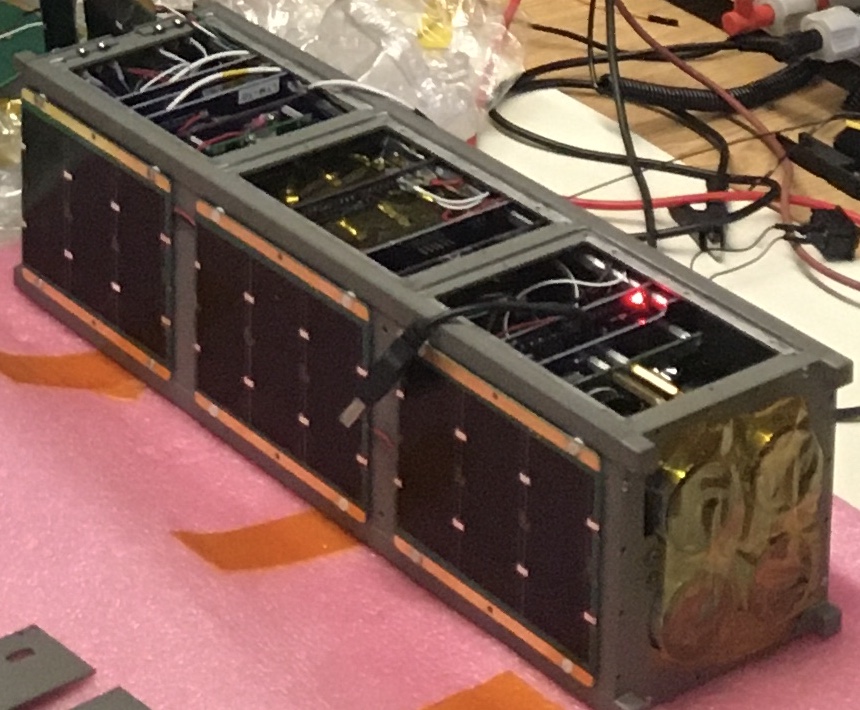
GOLF-TEE Mission
We have Golf-Tee which stands for Technology Exploration Environment. Key features of it are:
It has deployable solar panels that we are developing inhouse. These address the need for more power.
We have secured CubeSpace ADCS, that we will use for the Attitude Detection and Control System. We were working earlier with a startup that would have given us the opportunity to fly cheaper and be part of the development but that did not come to fruition. We looked at a long list of possible ADCS systems and decided that CubeSpace would be suitable for our GOLF-TEE, GOLF-ONE and possible beyond.
We have the RT-IHU, Radiation Tolerant Internal Housekeeping Unit, which was developed as an ASCENT project using COTS, commercial-off-the-shelf, parts intended to reduce the number of upsets that cause the IHU to “latch-up” and have to re-boot. We’re going to compare that to the IHU we had on the legacy LTM, linear transponder module, used in the FOX satellites to see if, with the South Atlantic anomaly problem, if we are doing any better with resets on each of those IHU systems.
For the 10 GHz X-Band we’re going to have an experimental microwave high speed data downlink which is tricky at LEO, but as we get higher at HEO there is a lot of data we will want to download, not to mention that from experiments. It also gives us an opportunity to possibly use it as a transponder where we would pick off the downlink from the V/U transponder and send it down on 10 GHz as an entryway for people to try working with the microwave bands.
For the GOLF-Tee mission, we are looking at a 500-550 km LEO orbit, accessible through a CSLI/ELaNa launch. Its purpose is to test and qualify new technologies. It will carry the Vanderbilt/ISDE Low Energy Proton Experiment that we have flown before. This will help provide a comparison of what the environment is like with the IHU, RT-IHU and L-IHU units.
We should have a good radio footprint at 550 km. It’s orbital debris regulation “friendly” because it will decay rather rapidly with the current sunspot cycle. We’ll see how that goes because when we go will make a difference.
GOLF-1 Mission
The goals for GOLF-1 are the same as GOLF-TEE that are, hopefully, developed quite well. In the meantime, though, if there are things with the construction or during the on-orbit phases, then hopefully we will have time to make adjustments to improve on things. That’s always the way you want to go with a series of similar satellites.
This will be a typical mission versus the technology mission that GOLF-TEE is. We will carry STEM, educational based experiments. We have a high school in the San Diego area that wants to fly a camera for earth weather views. We’ll fly the Vanderbilt/ISDE Student Radiation Experiment again because there are a lot of students who like to put those together and write papers.
We’ll expand the microwave/SDR experimentation. We’ll open up the Five and Dime – that’s the 5 GHz uplink to 10 GHz downlink. Of course, at LEO it is tricky at best. Nonetheless, it will be there for experimentation with GOLF-1.
The S-Band/X-Band transponder – 2.4 GHz uplink and 10 GHz downlink (a la QO-100) – will be available.
And, we have a L-Band 1.2 GHz uplink possibility. We aren’t certain what that will be used for, perhaps commands. It’s not a worldwide band so depending on resources, we’ll probably concentrate primarily on the other bands.
Again, we’ll have a standard V/U transponder operation. However, it will be the SDR, not the LTM so it gives us the opportunity to make the transponder a variety of things such as an FM repeater or a linear transponder.
Readiness Dates
The target Readiness Date for GOLF-TEE is December 1, 2025. The Readiness Date indicates to NASA that we are ready to hand it over for integration. Integration is the activity when the satellite is put into the dispenser that then goes to the rocket. NASA holds off basically until our CDR, or Comprehensive Design Review, which will be March 2025 and looking at that readiness date in order to judge when to find a good launch for us.
The integration is typically 45 days prior to launch therefore we would not see a launch until early 2026. But it could happen that fast as they have been pretty good at lining up some launches.
For GOLF-1 the Readiness Date would be a year later, December 27, 2026. Again, we want to look at everything we can learn from GOLF-Tee and put it into GOLF-1 and make it better.
GOLF-2 and Beyond
From GOLF-2 and beyond the push for opportunities, and I say it is a good push, opportunities for higher than LEO are going to require specialized systems. We know that and is why GOLF-2 will be testing more of these systems.
The deorbit devices are just coming to commercial availability in CubeSats which is very good. They were not available until just recently. We saw at the CDW, CubeSat Developers Workshop quite a few companies with some items coming out that are helpful to us. We have a team looking at thrusters and propulsion in the ASCENT group, ASCENT meaning Advanced Satellite Communications and Exploration of New Technology.
These things can be mastered, I like to use that word, developed and mastered in LEO. We’ll be careful about what we fly so it will be a successful mission as we go for those higher and more expensive orbits.
[ANS thanks Jerry Buxton, N0JY, AMSAT VP-Engineering for the above information.]


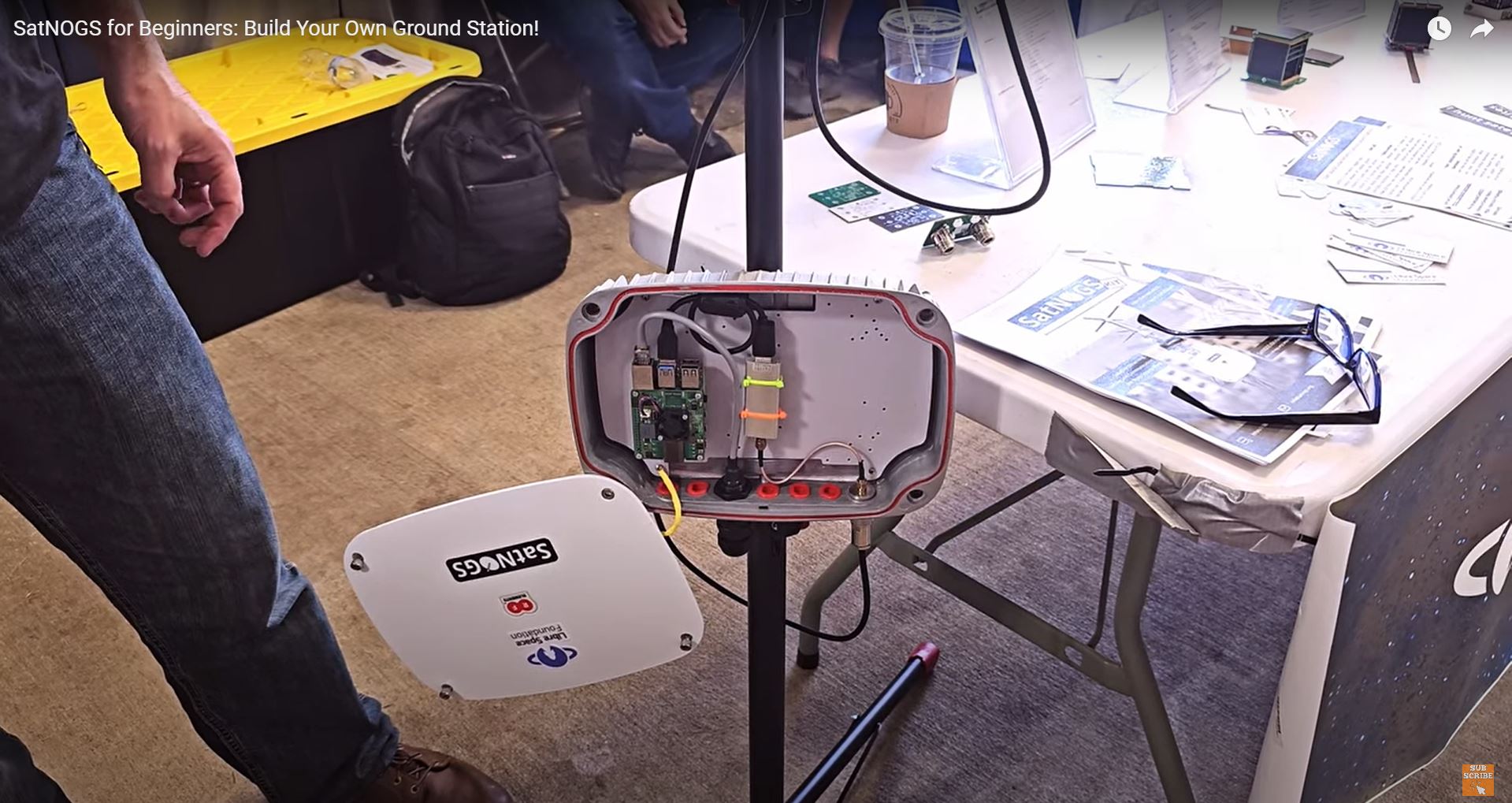
![Robert Theiss, W5ITR, interviews Dan White, ADØCQ, with Libre Space at the 2024 Dayton Hamvention. [Credit: Robert Theiss, W5ITR]](https://www.amsat.se/wordpress/wp-content/uploads/2024/06/SatNOGS-video-image.jpg)