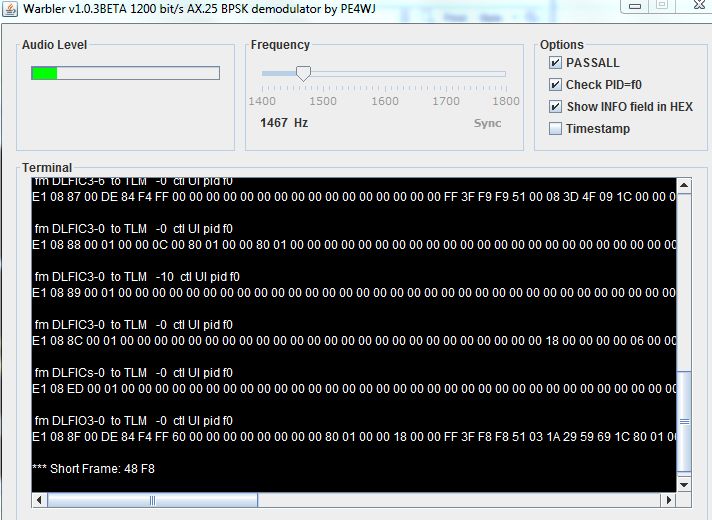
My first copy of the DO-64 Delfi C3 satellite beacon. Strong signal.
 AMSAT-SM - Official Website of AMSAT-SM Sweden
Webmaster and member of the AMSAT-SM steering group.
My first copy of the DO-64 Delfi C3 satellite beacon. Strong signal.
Då har vi fått en ny satellit med Oscar-nummer!
William A. (Bill) Tynan, W3XO, OSCAR Number Administrator has
confered on SHIN-EN2 the designation Fuji OSCAR-82 or FO-82.
In reply to Seiji Fukushima’s, JH6RTO, request for an OSCAR number,
Bill said, “I along with all in AMSAT-NA and the world’s Amateur
Radio satellite community congratulate you and all involved with Fuji
OSCAR-82 and trust that it will fulfill all of its mission
objectives. FO-82 joins an illustrious line of Fuji spacecraft built
and launched by Japan.”
Shin-En2 is a 17 kg satellite measuring 490×490×475 mm built by
students at Kagoshima University in Japan which will carry a 145 to
435 MHz linear transponder into a deep space orbit.
The aims of the mission are:
* To establish communication technologies with a long range as far
as moon.
* To establish a new technology of the ultra-light-weight satellite.
Proposing a WSJT 29dBm UHF downlink and a 29dBm 20 kHz linear
transponder and a CW beacon all on UHF with a VHF uplink for the
transponder
The orbit will be quite different from the previous satellites. Shin-
En2 will have an elliptic orbit around the Sun and travel to a deep
space orbit between Venus and Mars. Its inclination will be almost
zero, which means Shin-En2 will stay in the Earth’s equatorial plane.
The distance from the Sun will be between 0.7 and 1.3 AU. An
Astronomical Unit (AU) is 149,597,871 km.
Shin-En2 IARU coordinated frequencies:
* 437.505 MHz CW beacon
* 437.385 MHz WSJT telemetry
* Inverting SSB/CW transponder
– 145.940-145.960 MHz uplink LSB
– 435.280-435.260 MHz downlink USB
Shin-En2 launched in the 4th quarter of 2014 with another amateur
radio satellite, ARTSAT2:DESPATCH, on a H-IIA rocket with the
asteroid explorer Hayabusa 2 as the main payload.
Kagoshima University satellite development team
http://tinyurl.com/Kagoshima-Satellite
Shin-En2 English Website
http://www.eee.kagoshima-u.ac.jp/~fuku-lab/sinen,english.html
ARTSAT2:DESPATCH – Art and Ham Radio in Deep Space
http://amsat-uk.org/2013/11/03/art-and-ham-radio-in-deep-space/
[ANS thanks AMSAT-NA and AMSAT-UK for the above Information]

Very nice signal today from FUNcube-2.
En uppdatering från FUNcube-teamet om FUNcube-2:
Limited testing of the FUNcube-2 linear transponder on the UKube-1 spacecraft has been undertaken during the recent holiday period.
This testing has shown that the transponder is able to work effectively and that it is capable of a similar performance to the transponder already operating on FUNcube-1.
AMSAT-UK and the FUNcube team have now submitted a detailed report on the testing to the UK Space Agency, who are the owners and prime operators of the UKube-1 spacecraft. It is expected that a meeting will be held with them late Jan/ early Feb to plan possible future testing and operations.
http://funcube.org.uk/2015/01/05/funcube-2-update-january-2015/
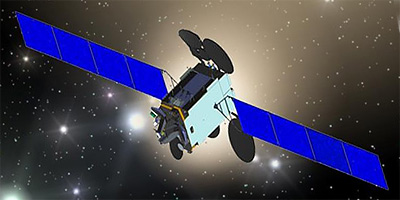
Från ANS kan vi nu läsa att det finns kontrakt att skjuta upp den
geostationära satelliten Es’hail-2 under senare delen av 2016. Det
speciella med denna satellit är att den kommer att ha en
amatörradiotransponder ombord.
Personligen tycker jag detta är den största händelsen inom
amatörradiosatelliter sedan Phase 3D. Vi får hoppas att det går i lås
och att flera tillverkare kommer att erbjuda paketlösningar för
mottagning av 10 GHz och sändning på 2.4 GHz.
Geosynchronous Es’hail-2 with Amateur Payload Contracted for 2016 Launch
The new satellite will be positioned at 26° East. In September 2014, a
contract with MELCO was signed to build the satellite based on the DS-2000 bus. In
December 2014, a launch contract was signed with SpaceX to launch the
satellite on a Falcon-9 v1.1 booster in late 2016.
Es’hail 2 will also provide the first Amateur Radio geostationary
communication capability linking Brazil and India. It will carry two “Phase 4” Amateur
Radio transponders. The payload will consist of a 250 kHz linear transponder
intended for conventional analogue operations in addition to another transponder
which will have an 8 MHz bandwidth. The latter transponder is intended for
experimental digital modulation schemes and DVB amateur television. The
uplinks will be in the 2.400-2.450 GHz and the downlinks in the 10.450-10.500 GHz
amateur satellite service allocations. Both transponders will have broad
beam antennas to provide full coverage over about third of the earth’s
surface. The Qatar Amateur Radio Society and Qatar Satellite Company are cooperating
on the amateur radio project. AMSAT-DL is providing technical support to the
project.
[ANS thanks Gunter Krebs for the above information]