Categories
Ham Satellite news

AIST-2D och SamSat-218D

Den 28:e april kom oväntat två nya ryska satelliter med amatörradio ombord, AIST-2D och SamSat-218D. Det verkar dock som om kontakten med SamSat är bruten för tillfället (9 maj).

Frekvenser:

Frequency information from Dmitry R4UAB

http://r4uab.ru/?p=11842

AIST-2D / RS-48 Downlinks
• 435.3065 – 435.3235 MHz Telemetry Data
• 435.3565 – 435.3735 MHz Telemetry Data
• 433 – 438 MHz 200 watt Synthetic Aperture Radar (SAR)
• 8025 – 8393 MHz Remote Sensing Data

http://spaceflight101.com/soyuz-lomonosov/aist-2d/

SamSat-218D
• 145.870 MHz Morse CW beacon transmits “SamSat-218D” every 150 seconds
(or 30 seconds)
• 145.850 – 145.890 MHz TRXSSAU downlink
• 435.590 – 435.610 MHz TRXSSAU uplink

Källa: ANS

Categories
Ham Satellite news

NuSat-1 kommande satellit med linjär transponder

NuSat-1 är en satellit från AMSAT Argentina som kommer att innehålla en linjär SSB-transponder. Den är planerad att komma upp den 30 maj 2016 i en bana på höjd 500 km och inklination på 97.5 grader.

NuSat
Foto: AMSAT Argentina

UPDATE May 30, 2016 at 1300 UT: ÑUSAT-1 and ÑUSAT-1 launched and deployed successfully, signals reported from both telemetry beacons. Satellogic reports “All Systems: Nominal”.

AMSAT-LU reports both satellites are sending strong TLM on 436.445/437.445 at 9K6/19K2 GFSK. During first few days they are being stabilized, after that the U/V linear transponder will be activated on ÑUSAT-1. A notice will be given on the AMSAT Bulletin Board (AMSAT-BB).

Transpondern kallas LUSEX och har följande frekvenser:
Uplink: 435.935 MHz till 435.965 MHz
Downlink: 145.935 MHz till 145.965 MHz. Power output: 250 mW
CW beacon: 145.900 MHz power output 70 mW.

Categories
Ham Satellite news

Tre nya Cubesat 22 april

Det är tre nya Cubesat på gång för uppskjutning den 22 april (2016) från Guiana. Här kommer frekvenser:

OUFTI-1 D-STAR sat:
145.950 MHz (FSK AX.25), and D-STAR down
145.980 MHz CW beacon
435.045 MHz Uplink

CubeSat e-st@r-II (läs mer om den här):
437.485 MHz CW and 1.2 k AFSK

AAUSAT4:
437.425 MHz (oklar modulation, säkert CW och någon typ av telemetri)

Categories
Telemetry

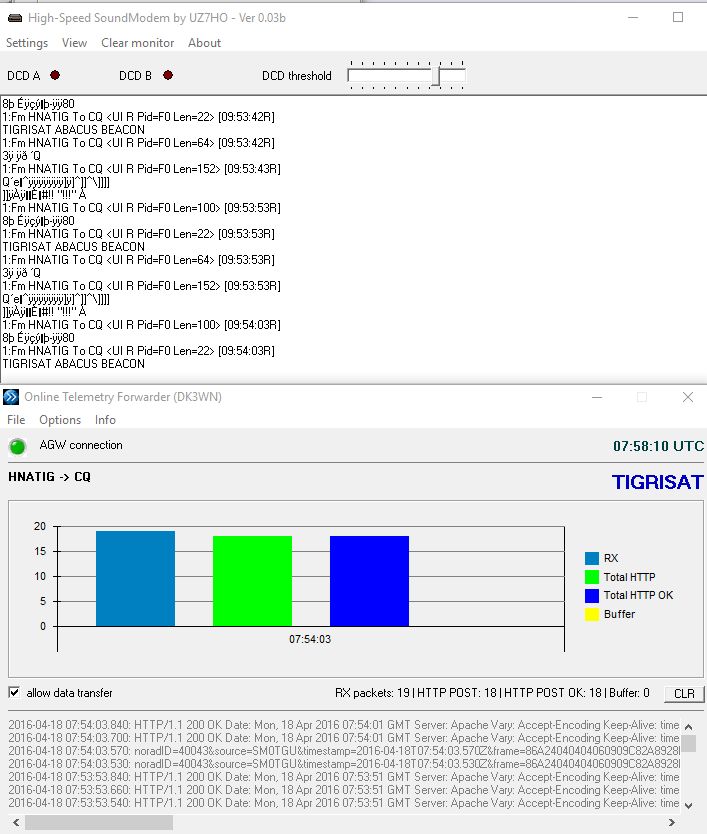
TIGRISAT beacon 2016-04-18

At 435.002 MHz. 9k6 FSK. Online Telemetry Forwarder v0.6.2.

Tigrisat_telemetry_20160418

Categories
Telemetry

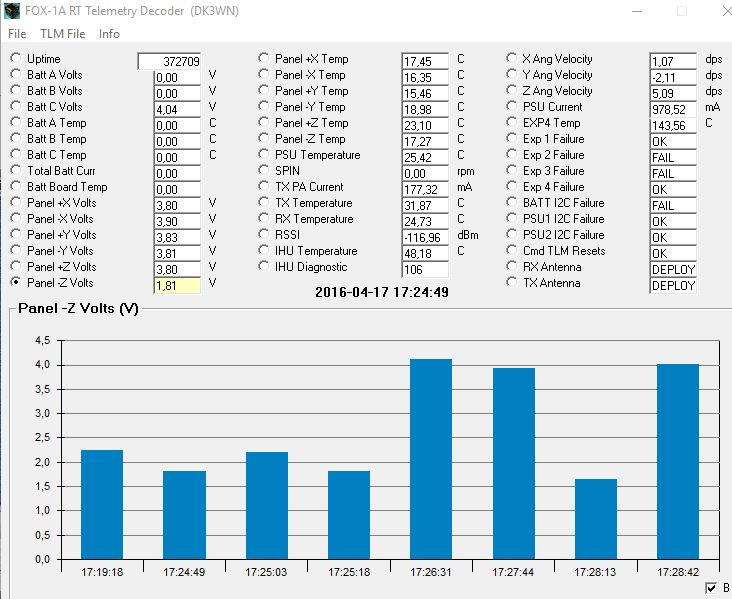
AO-85 Fox-1 telemetry 2016-04-17

17:20 UTC pass over Sweden:

Fox1A_telemetry_20160417

Categories
Ham Satellite news

Var först med att höra e-st@r-II CubeSat

catch_signal1

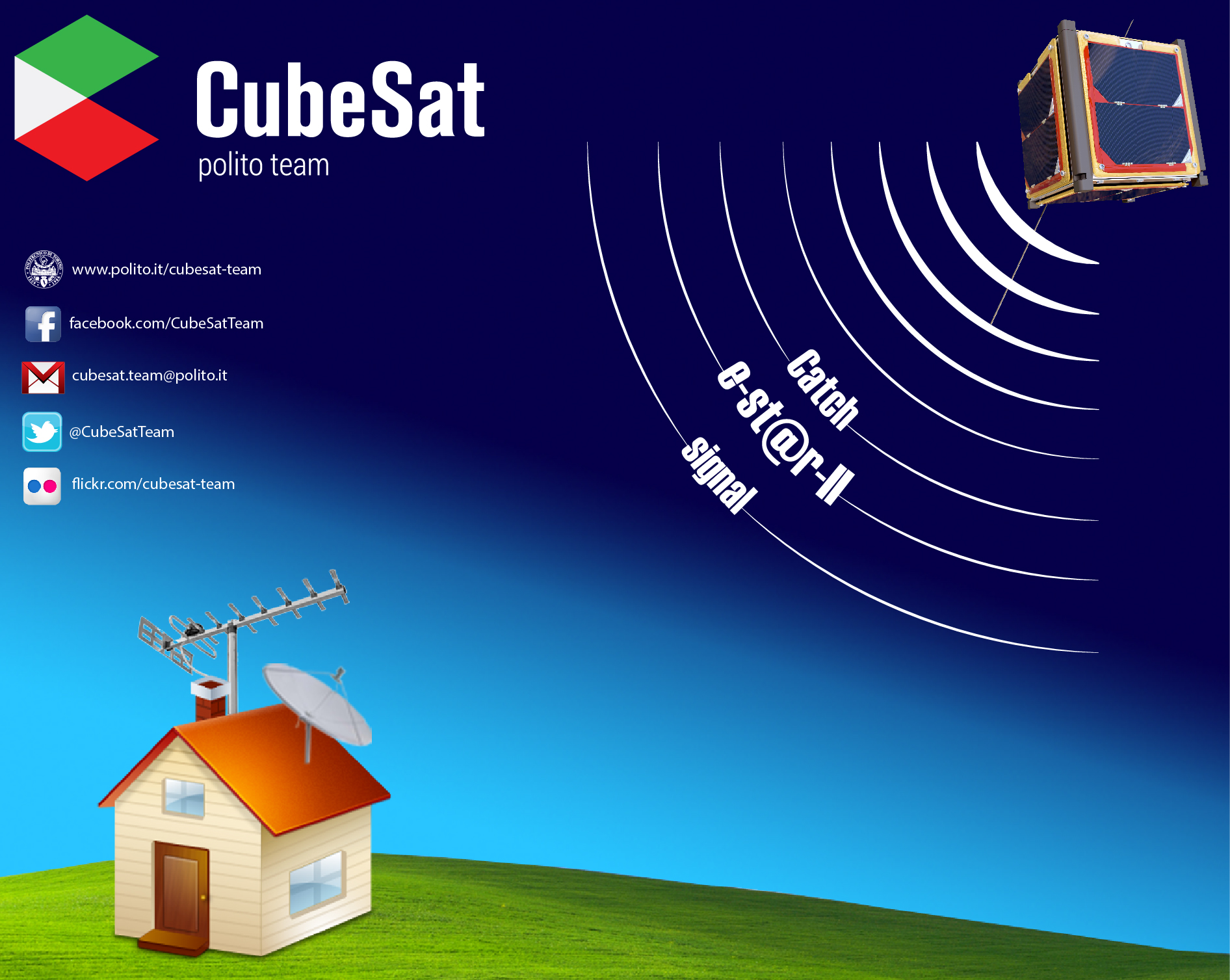
Satelliten e-st@r-II är planerad att skjutas upp den 22 april (2016) och teamet bakom satelliten anordnar en tävling med att bli först att höra satelliten. Läs mer:


To celebrate the launch of our second CubeSat, e-st@r-II, we invite the amateur radio community in a contest to listen out for our satellite.

The launch is scheduled on 22nd April 2016, from Centre Spatial Guyanais spaceport in Kourou on-board Soyuz ST-A VS14. The deployment of the satellite will be completed almost 10100 seconds after lift-off!

The competition is divided into two parts, independent of each other:

  • Be the first to send in your recorded signal and TLM packet from e-st@r-II
  • Be the one to provide us the major number of recorded signals and TLM packets in the first month from deployment of e-st@r-II in space

Prizes are:

  • e-st@r-II poster with signatures of the team members
  • certificate to attest your achievement
  • celebration T-shirt

Once deployed into orbit, e-st@r-II will begin transmitting signals to Earth approximately 30 minutes after activation. Signals can be picked up by anyone with common amateur radio equipment. You can send the recorded signals (audio and/or waterfall) and TLM packets via email (cubesat.team@polito.it) or upload it using the serviceDropItToMe (the password is radioham).

e-st@r-II downlink features:

  • Status: LAUNCH ON 22/04/2016
  • Primary telemetry downlink: 437.485 MHz, 1200 Baud, AFSK, AX.25, 500mW
  • Transponder beacon: 437.485 MHz, CW, 500mW
  • Destination: “ALLALL”
  • Source: “ESTAR@2”
  • Callsign: alias E-STAR-II
  • TLM DECODING SOFTWARE: link (v1.1 – updated on 12/04/2016)

For more information about the e-st@r-II mission please see the dedicated page.