
Re-post from ANS-270:
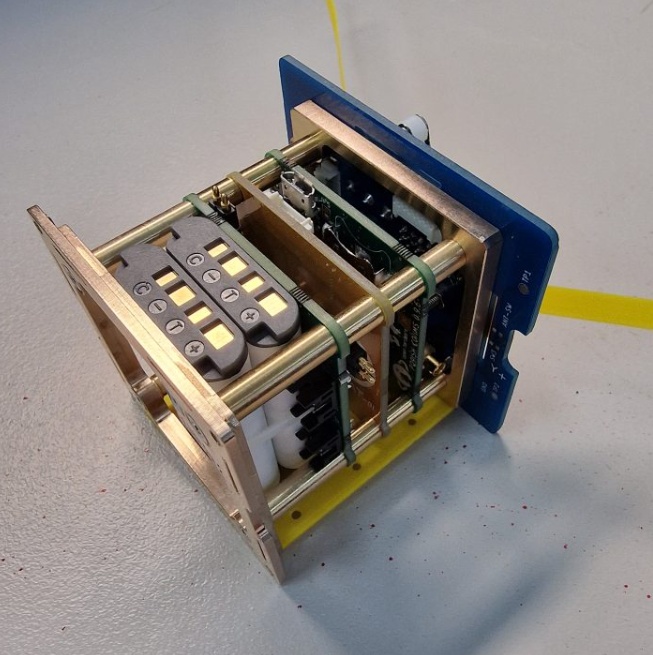
It’s official: AMSAT-DL’s three ERMINAZ-2 PocketQubes – ERMINAZ-2U, ERMINAZ-2V, and ERMINAZ-2X – are set to launch aboard SpaceX’s Transporter-18 rideshare mission from Vandenberg Space Force Base on Thursday, October 1, at 18:18 UTC (20:18 CEST), AMSAT-DL announced on September 25. The three spacecraft will be deployed from UARX’s OSSIE mission using a PocketQube deployer provided by the Libre Space Foundation into a 500 x 600 km polar orbit.
The trio shares an identical design derived from AMSAT-DL’s ERMINAZ-1 spacecraft, which were built on the Libre Space Foundation’s QUBIK platform and still await the first flight of Rocket Factory Augsburg’s RFA One from SaxaVord Spaceport in the United Kingdom. That makes the ERMINAZ-2 satellites the first of the ERMINAZ family to reach orbit. AMSAT-DL describes the build as its shortest satellite campaign to date: when the launch opportunity arose in early 2025, the flight models had to be ready for integration into the deployer within a matter of weeks. The satellites were originally manifested on Transporter-14, then Transporter-16, before settling on Transporter-18.
The ERMINAZ program is a syndicated multi-PocketQube mission led by AMSAT-DL in collaboration with AMSAT-EA, ESERO-Germany at the Bochum Observatory, and the Libre Space Foundation, with the goal of promoting, advancing, and developing knowledge about space and amateur radio. Each of the three ERMINAZ-2 spacecraft will transmit telemetry and science data from onboard radiation sensors and triaxial accelerometers, gyroscopes, and magnetometers, downlink SSDV images, and provide a digipeater and store-and-forward function allowing licensed amateurs to use the satellites as relays to communicate with one another worldwide. Only non-proprietary, open-source, and documented protocols will be used, including CCSDS telemetry, a CW beacon with callsign identification, SSDV, and AX.25, along with in-flight experiments using GFSK, GMSK, and BPSK modulation at data rates from 600 to 19,200 bps and both CCSDS and IEEE 802.15.4 framing.
The IARU has coordinated the following frequencies: ERMINAZ-2U will operate in the UHF amateur satellite band on 435.900 MHz, while ERMINAZ-2V and ERMINAZ-2X will operate in the VHF band on 145.920 MHz and 145.960 MHz, respectively. AMSAT-DL notes that these frequencies are to be used only for amateur purposes. Operators wishing to decode the satellites will find that Daniel Estevez, EA4GPZ, added a decoder for the ERMINAZ family’s QUBIK-derived communications stack to gr-satellites in 2024, and telemetry reports via the SatNOGS network will be welcomed.
Transporter-18 is shaping up as a banner flight for amateur radio: AMSAT-EA’s UNNE-1B and HADES-L and Argentina’s UTNH-Sat are also manifested on the mission (see story above). Further details on the ERMINAZ program are available at https://amsat-dl.org/en/erminaz/
[ANS thanks AMSAT-DL and the IARU Satellite Frequency Coordination Panel for the above information]