
Re-post from ANS-270:
AMSAT-EA’s UNNE-1B (also known as HADES-E2) has moved to the list of completed coordinations on the IARU Satellite Frequency Coordination Panel’s status pages, with a downlink on 436.888 MHz and an uplink on 145.925 MHz now coordinated – just in time for a launch that could put three new amateur payloads in orbit next month.
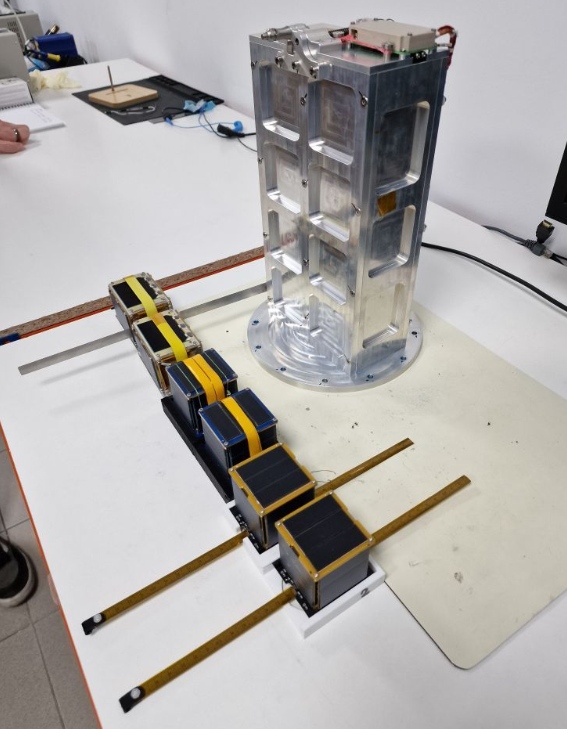
Last covered in ANS-214, UNNE-1B is a 1.5P PocketQube built on the same hardware and software as the original UNNE-1, which continues to await a Rocket Factory Augsburg launch from the United Kingdom. The satellite provides an SDR-based FM voice and FSK digital repeater, opened by squelch level with no tone required, along with FSK data at 50-1200 bps, telemetry at up to 1600 bps, a CW beacon, and a CODEC2 digital voice message. AMSAT-EA has positioned it as the successor to the FM repeater service of SO-124 and SO-125, both of which have since re-entered the atmosphere. An educational payload developed by students at Universidad de Nebrija in Madrid will send one clue per week in the telemetry as part of a guessing game for amateurs to solve.
UNNE-1B is manifested on SpaceX’s Transporter-18 dedicated rideshare mission from Vandenberg Space Force Base, with the launch brokered by UARX. Transporter-18 is currently scheduled to launch on Thursday, October 1, at 18:18 UTC.
Two more amateur payloads are planning to share the ride. AMSAT-EA’s HADES-L, an experimental 10 x 5 x 5 cm PocketQube reported in ANS-214, proposes a transponder with an uplink at 28.472 MHz USB – or alternatively on 145 MHz – and a 436.665 MHz FM downlink, capable of carrying a single FM voice channel or multiple simultaneous CW, FT4, or FT8 signals. And UTNH-Sat, from the Universidad Tecnologica Nacional Regional Haedo in Argentina, will transmit LoRa telemetry and a CW beacon on 436.850 MHz and offer an automatic LoRa ping-response service: amateurs who transmit a ping request to the satellite will receive a reply containing their own callsign. Both remain in the coordination process (see the coordination roundup below).
[ANS thanks AMSAT-EA, the IARU Satellite Frequency Coordination Panel, and Exolaunch for the above information]